Showing posts with label vintage. Show all posts

Thursday, January 14, 2016

Vintage Thursday - The Owl Cable

For the past couple years I have noticed a surge in the popularity of knitted owls, especially cable owls. Recently I was asked to make this owl cable hat, but the cable owl is so versatile and easy that it's found in sweaters, mittens, gloves... just about anything. But, this being Vintage Thursday, I feel compelled to point out that (like many clever motifs) the owl cable is not a new innovation.

Enter Workbasket and Home Arts Magazine (Number 3, Volume 37, December 1971):

This volume has been well-loved
I received a slew of old Workbasket magazines from my grandmother a couple years back, mostly for the early part of the 1970's. They are a real study in changing domestic fashion, addressing everything to husbands making comments about your thighs being like saddlebags, to growing violets and making granny square ponchos. (I'm definitely going to write more about them in the future, especially the granny square fad.) One of the interesting things about this issue is the Owl Snowsuit, which my grandmother has noted in her scrupulously neat handwriting on the tattered cover.

 Do you see those googly eyes? Yes, those are owl googly eyes!

Unfortunately, this pattern only comes in size 1, 2 and 3. But there's the sweater AND mittens with owls! I'm really tempted to make the mittens, but with a modification: instead of sport weight yarn on US #3 dpns, I'd use worsted weight yarn, just like the plan mitten pattern from 1944 I use calls for to keep the chill out.

Thursday, October 29, 2015

My Camera Hates Me

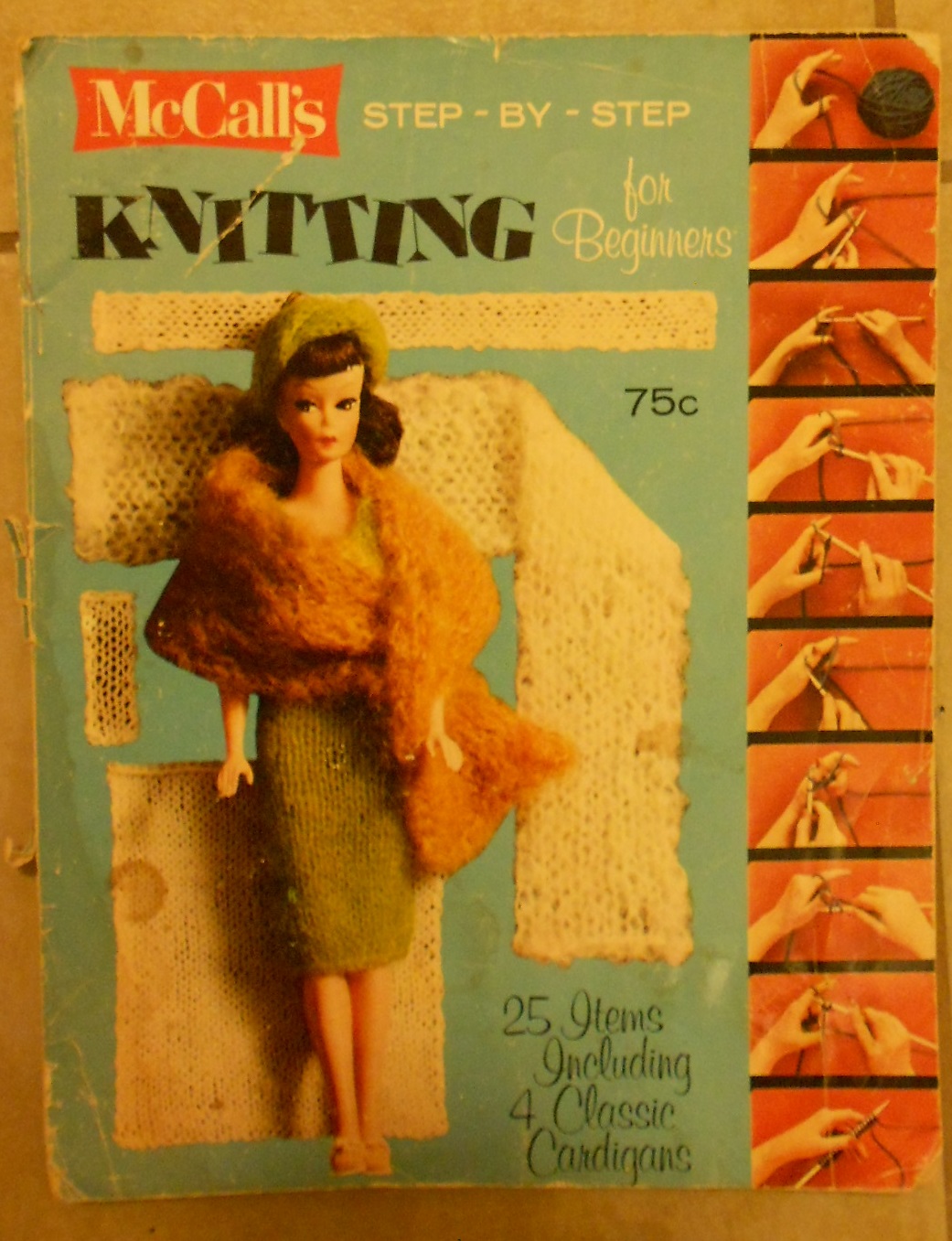
I knit V. a really lovely, simple cardigan recently, and just got the buttons on it this weekend. It's from a 1965 pattern for a girl's raglan sweater in fingering. However, as the title of the post says, my camera hates me. Here is a terrible photo of the book:
And here is a terrible photo of the pattern in the book:
And here is a truly horrendous photo of my finished project:
I swear, this really is a nice sweater, but I'm experiencing a profound level of resistantalism. Photos I took last week on this camera (set to Auto) came out just fine (you know, if you like pumpkin patches):
But try to photograph a sweater I spent about two weeks knitting? Noooo.
 
But anyway, here are the fun facts:
 
Child's Raglan Sweater (1965)
Needles: US #1 & #2
Yarn: KnitPicks Palette in Navy (about 4.5 balls)
Notions: 7 5/8" navy plastic buttons
 
I could not tell you the gauge, because I did not check. Probably about 7 sts = 1 inch in the stocking stitch body, which was on US #2 needles, because that's a typical size for me to use and it usually runs about that.
 
I'm fairly certain I have almost this exact same pattern in another vintage book that is seamless, but I was too impatient to dig it out. (By the time I did, V. would probably have been size 7, instead of size 6.) V. complained at first try-on that it was itchy, so I gave it a good soak in conditioner, which seems so far to have solved that problem because she hasn't complained again. I ironed on a name tag I usually put on all her outwear so that the sweater won't get lost at school. This is a real problem. Six year olds are not known for remembering where they put their cardigan, much less anything else, unless you don't want them to have it. Last year she had a store bought navy cardigan very similar to this one which she lost on the first day of wearing it. This cardigan cost me roughly the same, if not a little less, than the store bought one, so I am not losing it.
 
I actually like this pattern well enough that I'm considering making her one in another color, such as Kelly Green or yellow. A simple pattern like this has a lot of potential, because if I wanted, I could make it Fair Isle, or anything else I want. We'll see.
 

Friday, September 11, 2015

The quest for thread

Yarn substitution can be a tricky process. If you are lucky, you will not find yourself substituting yarn for a project that calls out discontinued yarn. The more time passes, the higher the likelihood of this being the case. Fashions change, as well as resources, so what may have been considered a common yarn 20, 30, or even 80 years ago may not be as common now. It may be so uncommon that serious research is involved just to find out what it really is. (More on Victorian knitting later!)
 
The Daffodil Doilie project I have been crocheting calls for discontinued yarn. Specifically, either J. & P. Coats or Clark's O.N.T. Best Six Cord Mercerized Crochet, Size 30.
I consider myself fortunate that these brands at least ring a bell. J. & P. Coats and Clark's is now more commonly known under the name Coat's and Clark's. According to their website (which has a fairly entertaining timeline about their history, if thread history interests you) O.N.T  ("Our New Thread") is a special six cord, soft finished thread for sewing machines first marketed in 1860.
 
Now, I don't know about you, but I'm fairly certain this pattern from 1949 is not asking me to crochet this doilie out of sewing machine thread. I gather that O.N.T. has become a trademark, having made a big splash back in Victorian times. A straight Google of O.N.T. Best Six Cord Mercerized Crochet, Size 30 gets me more in the realm of what is typically thought of when we say "crochet thread" - that is, this discontinued thread. 1949 really wasn't very long ago, and if I was die-hard about it, I could probably set up an alert on eBay to purchase the exact thread this pattern calls for in vintage yarn.
 
I opted for something manufactured within the past decade instead, and for several reasons. I didn't really want to wait to find the thread and wait for it to be shipped. Who knows when it would turn up? Waiting during shipping is hard enough. But impatience aside, I've learned the hard way that cotton just doesn't hold up as well over the years as wool or other fibers. I've had many a strand of vintage embroidery or crocheting thread disintegrate on me as I worked it, but have never had it happen with wool. 
 
There are several big players in the modern market of crochet thread. Aunt Lydia by Red Heart (which is owned by Coat's and Clark's) and DMC come foremost to mind. However, in size 30 both brands come in a limited range of colors. (Think "50 Shades of White.") In the end, I went to a brand I'd never heard of, Omega Hilo Crochet in Pistachio and Bright Yellow. I still don't know much about them, but I do know something essential: they have Size 30 crochet thread in OVER 60 COLORS. And it's accessible. (More on my heart wrenching quest to get Brown Sheep Nature Spun Fingering balls in specific colors later.)
 

Thursday, September 10, 2015

Daffodils

Every now and then, such as when spring arrives, I get the overwhelming urge to make something crazy challenging. This spring, it's a doilie.
 
I've been spending a considerable amount of time researching vintage and antique patterns this past year. One of the fruits of my labor is a newfound appreciation of mid-century handicrafts. Handicrafts, like fine arts, sometimes require a person to become familiar with the genre they belong to before they can be understood, if not liked. In a fit of spring fever, I decided I liked floral doilies, such as the one featured below in "Floral Doilies, Book No. 258" (1949) from The Spool Cotton Company.
The pattern is also available here.
One of the first things I noticed about this pattern (aside from it using Size 30 yarn, which is not available at the corner drug store, let me tell you!) is that it uses a shade of green called "Nile Green," which is very similar to sage green. "Nile Green" was very popular during this era. I see it over and over again in household crochet patterns, and I'm very curious as to its origin and if it crossed over into knitting as well.  

Ignore the dirty nails!
Size 30 crochet thread is, admittedly, a tad wee. There were times when I thought I might go blind, or at least experience debilitating eye strain. I can't recommend a good task light highly enough, especially since I don't have one and had to rely on leaning toward the sunlight at a window like a desperate houseplant.
Daffodils deconstructed
The actual design is rather simple. You make the trumpet shape for the center, then make a loop with the petals that then gets sewn onto the trumpet. Easy, right?
 
The center of the doilie - the "Nile Green" portion - I got done in about 4 hours.
 
One daffodil took me all of a Saturday.
 
The first daffodil triumphantly adhered!
Strangely enough, there are supposed to be 11 daffodils. At one daffodil a weekend, I'll basically be done with this sometime this winter. This is about where I am now:

Thursday, February 06, 2014

Vintage Thursday: Argh-yle Stockings

I have been struggling all week with the Men's Argyle Stockings. I'm learning the hard way that it is very, very important to not have too much tension on the yarn you are carrying on the back of a colorwork piece. I already sort of knew this, but I didn't know it in such shocking technicolor as I do now.
The puckering is my tension problem. Which causes a tension problem. In my temples.
This pattern conspired against me. The colorwork goes all the way around the stocking, and when I got to this point I had my housemate try it on because of some kind of subconscious fear I was having. And as it turns out, my fear was justified. It didn't fit. It didn't fit spectacularly. He could only get his foot half way down the stocking, if even that far. The colorwork area just didn't stretch much, and the pattern has one reduce to about 76 sts just before the ankle. That's not exactly giving one a lot of room on US #1 needles to begin with. My entire stocking (well, OK, 2/3 of it) was FUBAR. And that wasn't even addressing my issues with the foot.
He fit it until about here.
I did have the foresight to work the heel with the additional thread that Jawoll sock yarn has in its skeins just for that purpose. I was feeling pretty good about myself at that point, but then I looked at the directions for the colorwork on the foot.

I was expected to simply carry the red on the back of the black all the way across the sole.
All my loose ends.
And I did. I tried. It lasted about two inches, and then I noticed my tension problem. So I cut the red yarn and knotted it at the end of every row. Not a pretty solution but it seemed workable at the time. Another inch or two in and I had the housemate try the thing on. And as I have already mentioned, I had problems. I had to backtrack a considerable distance.

Of course, all that cutting and knotting on the foot means that unraveling becomes complicated. I took a breath and just chopped the foot off.  

This was Tuesday. Or Wednesday. It all just kind of blurred together in my head, as these kind of things do. I may have a kind of knitting trauma, since I have practically knit this stocking twice already. Plus, it is just so darned cold. I don't fare well in these East Coast winters and reknitting a hundred or so rows on US #1 dpns didn't exactly warm my hands any. Somehow, I carried on.

I started unraveling the foot and using the yarn from it to knit the rest of the stocking leg again. I kept changing my mind about what kind of join to use, but at this point, does it really matter? It will probably block just fine. Or else.
I began at around where you see the safety pin, which coincidentally marks Row 100 of the colorwork. I am not decreasing from this point on, and I'm being much more careful about my tension. Right now, I'm at about Row 145 of the colorwork, and have about 20 more rows to go before beginning the heel flap all over again. Contemplating that ridiculous carrying business (Part of why Argyles are worked flat, dagnabbit!) has me cunningly considering other approaches, such as a sole worked separately, or modifying the pattern to work it flat. I'm on the fence about it. All I'm really certain of is that I am certainly not doing it the way they say to do it in the pattern.

Friday, January 31, 2014

Rummaging

Off and on this week I have been plugging away at the Men's Argyle Stockings, and I have only needed to rip it out an inch or two every now and then. Not so much as to be going backwards; the progress is forward, overall. Especially now that I've gotten past the tricky bits of the calf shaping. (The instructions basically told me to wing it the first couple rows! The gall of some of these old patterns!) I'm now in a rather happy place with these stockings, somewhere around Row 80 of the color work portion.
Safety pin marking Row 70.
Since I have vintage things on the brain lately, I've been digging about in my collection a bit. A while back I happened to come into possession of Susan Bates Presents 101 Ways to Improve Your Knitting (1968). I've had this little book before, back when I was learning to knit. I can't recommend it highly enough for beginners, because while it wasn't actually the book that taught me to knit, it certainly reinforced me in times ahead. Generally I recommend Knitting Without Tears to beginners, but it doesn't have ton of hand-holding pictures to help the novice along in moments of insecurity, and you really have to read through it to find what you are looking for. 101 Ways augments it perfectly, because it has a lot of pictures and (most importantly) has a very clear table of contents. It won't give you clever ideas or a knitting philosophy, or address advanced topics, but it will get you out of a jamb and clear your head.

I'm thinking about 101 Ways at the moment because in the back it has a pattern for Plain Socks and a pattern for Argyle Socks. The stockings I'm knitting are Argyle-ish, and not true Argyles. This pattern in 101 Ways is true Argyle. There is even a chart for making the diamonds.

Now, I have never actually made a pair of Argyle socks. I've wanted to for years, but just never got around to it. I'd probably be happiest making a pair from a pattern around the 1940's, when it seems hand knitting them was en vogue among college girls and just about anyone else with a pair of knitting needles to rub together, but this might do. So perhaps there will be Argyles in my future soon.

Among other things I found during my rummaging was this pattern, which came to me wedged between some vintage sewing patterns from my grandmother's.
1960's? 1970's? I don't know.
It's a pattern for a knitted vest, on a large sheet of paper that folds out like a map.


I've seen this kind of thing before in mail-order patterns, etc., but I couldn't say what exact decade this pattern is from, except to say that it doesn't reflect vanity sizing. As you can see below, a 34 bust is a Size 12 in this pattern.

The illustration gives one a reasonably vivid idea of how this knit would look. It's pragmatic, and not overly flattering. Nevertheless, I'm tempted to make it. But perhaps if I'm going to make a pattern at random, out of sheer curiosity, it should be one of the hand written mystery patterns I have. You know the kind; they're in your grandmother's or great aunt's sewing room, stuffed between the pages of a book or in an envelope somewhere. Someone, at some point, wrote down a pattern that someone else told them about. It might have been passed around the neighborhood, or passed around the family. Sometimes it's origins are very clear because it's titled "Aunt Violet's Cardigan" or some such. Well, I have a quantity of them, just as I have a quantity of hand written recipes that I've found in thrift store cookbooks. And maybe I'll make one of them. Right after the Argyles.

Thursday, January 30, 2014

Vintage Thursday: The Little Princess Baby Bootees

Don't let the name dissuade you; the Little Princess Baby Bootees are great unisex baby booties. There's none of the funky feminine frills found in some of the other vintage booklets I have. (And believe me, there is quite a bit in those. I may have to work some them up to prove it.) I knit a lot of bootees when I was expecting V., and these became my favorite. They are now invariably my go-to gifted bootees - virtually everyone I know who has had new baby around me has a pair of these from me. The perks to this pattern, aside from it's comparative readability, is the simplicity of the design and the fact that V. could not wiggle or kick them off. (That in itself was worth any amount of knitting fuss.)

Knit with Regia sock yarn on US #1 (2.25 mm) dpns
I love these bootees SO much, I am passing the pattern on to you. It is from Bear Brand-Bucilla Baby Book Volume 328, last copyrighted in 1944, so it is now in the public domain. I could just scan the pattern and try to sell it to you, but that somehow feels cheap to me. No offense to those who have done just that - I am grateful to you, since I use those patterns! But being the perfectionist I am, I don't feel like I'm working for it enough if I do that. However, in future I will offer for sale vintage patterns, with the catch that I will also include my interpretation of the pattern and knit a sample up myself, if possible. That seems far more appropriate.

The much loved (a.k.a. falling apart) cover of my copy.
And now, on to the pattern!

Little Princess Baby Bootees #1874

The Little Princess Baby Bootees are part of a set, but I've only included the bootees here.


I find that just about any fingering weight yarn will do. I've knit these bootees in everything from the coarser sock yarn like Regia or Jawoll to very soft, all merino yarn that has no added nylon. I used US #1 (2.25 mm) dpns, and found that the the sizing is pretty much correct: sometimes the bootees fit an infant, and sometimes a 3 month old, sometimes older. Kids vary.

As far as working the actual pattern is concerned, when it came to decreasing the sole I worked "k2tog, ssk" rather than "k2 tog twice," simply because it's more symmetrical, and I used the three needle bind off inside of a conventionally bound off and sewn seam. I also didn't make tassels; those instructions were not included anywhere in the booklet. I suppose knitters in 1944 just knew how to make tassels. (Along with argyle socks.)


I hope you enjoyed these bootees! Please feel free to comment with any questions or remarks.

Thursday, January 23, 2014

Funky Toddler Socks

I never have enough leftover sock yarn. It is just so incredibly useful, and not just for colorwork. You can make mitred square blankets, or (my personal favorite) baby socks. Now that V's older, it has moved on to toddler socks.
I lost the socks I originally used the yarn for. :(
Technically, I suppose this is "vintage" project, because the pattern I'm using is from my favorite vintage booklet, Bear Brand-Bucilla Baby Book, Volume 328. I've knit a ton of things from this booklet. My favorite is the Little Princess Set #1874 booties, which is the best bootie pattern I've found so far. They were the only booties I knit for V. when she was an infant that she couldn't kick off. It may sound like a little thing, but keeping socks and booties on kids is an epic battle, especially in the wiggly phase.
Still a little big on the kid
This sock is Sturdy Socks #1917. It's just a basic, all-around useful sock with a 1x1 ribbing up top that changes into a wider rib with a heel flap and round toe. Many vintage patterns for kids are very basic and practical like this - hence there are often titles on the booklets like "Practical Knitting", etc. - and I have seen patterns repeated almost verbatim in various booklets. (There's a lot of recycling in Bear Brand booklets.) I know we are spoiled by the abundance of patterns now available to the savvy Internet browsing knitter, and that we have grown quite accustomed to unique designs (sock patterns that move away from the linear process come to mind here), but there is something to be said for a good standard pattern. (On some very cold days, such as today, I feel like I'm channeling Elizabeth Zimmermann. I really need to knit some slippers.)
V. just about fits them now. I use them as over socks; she puts on a regular pair of machine-made socks, then pulls these on over top. Then I feel like we can finally go outside. It's that cold.

Thursday, January 16, 2014

Vintage Thursday: "White Popcorn-Stitch Headband"

I saw this headband years ago when I first moved to Boston on somebody's blog. I even acquired the pattern with the intention of making it, and in the odd way that the knitblog world works, I'm pretty sure I passed the blogger on the street in the North End while they were wearing the headband. We exchanged silent but meaningful knitter looks about the awesomeness of the headband, and then dissolved into the crowd. Really. The North End is crowded and the sidewalks are about two feet wide with poles sticking up all over them in inconvenient places, like exactly where you meant to stand. One can't ogle hand knits long on a North End sidewalk without beaming yourself on a pole.
From the etsy shop knitsomuch
I have upgraded my computer several times since then and even changed email accounts, so the pattern was lost to me in the chaos that is life. But yesterday I found it again, this time at an etsy shop called  knitsomuch that is selling pdf scans of pre-1960 vintage patterns. (Something I should think about since I collect vintage pattern books and magazines, and have had more than one person inquire about pattern sharing. I have been in the habit of just saying no because I haven't had the time or focus to look up the copyright issues.) It has a very mundane name, as many vintage patterns do: White Popcorn Stitch Headband (1960). The scanned pages included a couple other knits that appeared on the same pages, including the mysteriously titled Blue Chin Strap Cap, which I think I am going to knit just to see how it turns out.
The headband at rest
The pattern calls for US #9 needles, which may or may not be vintage sized... the gauge called for was 4.5 sts = 1 inch so I just made a judgement call. I have been hoarding saving a skein of Lamb's Pride Worsted in "Golden Mushroom" for a couple years with the intention of making a highly textured hat - bobbles or something - so it fit the bill for popcorns. (A note on popcorns: they were absolutely and utterly no fun until I realized I could use a crochet hook to make them, since they involve making 5 sts in ONE sts, and then slipping them all over the final stitch. Ugh!) Lamb's Pride Worsted allegedly works out at 4.5 sts = 1 inch on modern US #8 (5 mm) needles, so I just used those. If it came out a bit small it's not a problem because I am petite. In fact, that might be for the best.
Sometimes it's hard to pick a flattering facial expression
I braved the snow flurries today, then took these pictures, so please excuse me if I look a little dishabille and put out. Weather offends me sometimes. (Ok, most of the time.Why is it always too cold, too hot, or too muggy? I swear, the wind whistles through my room sometimes.)
I wore it tied behind my head, but next time I'm going to go for the chin strap position because my ears were a tad cold. But all in all, I'm really satisfied with it. I would consider making another one.

In other news, the results of the vintage UFO poll was very close. The winner (by one vote!) was the 1920's Argyle-ish stockings. Obediently, I have begun working on them.

I haven't even ripped them out much since restarting. Really.

Monday, January 13, 2014

Moths

If your weekends are anything like mine, then you spent them walking your four year old around to various errands, like shopping at the coop or the farmer's market in the pouring rain (Flood warning? Really?) and (lest you think it's all glamour here) darning. Because, you see, I have a moth problem.

I've never had moths before. I feel contaminated, and with good reason. They didn't get my stash but they sure took a bite out of the winter clothes I had boxed at the beginning of the summer. This included one of my first sweaters. I was not pleased with this, to say the least. Not only was this sweater from way back in 2005-2006 close to my heart, it also involved unraveling a $4 man's sweater and piecing the uneven pieces together as I knit, then carefully blocking its touchy self on what was probably my bathroom floor. Basically, this was one of my super-involved projects, and only owning the sheep and whittling the needles would have made it more work.

A big bite
The accursed moths ate right through the left-hand pocket. 
Seriously, right through it!
I don't have extra yarn to fix this hole. For a while, I did; but I guess I can't be expected to move a ball of recycled yarn across the continental US more than once. I learned my lesson about that, to be sure.

I unraveled the afflicted pocket and set the yarn aside, then re-knit the pocket with some yarn left over from the FLAK sweater I never completed, which is just a solid brown. I could have used fuchsia for all it showed, since the sweater has hidden pockets that are sewn down on the inside of the sweater. I used the salvaged yarn to alternately knit and sew the hole closed.
Yes, I'm obsessive.

Below you can see the inside of the sweater with the newly-knit pocket bottom in place. It's not offensively different than its original state, thankfully.
I can live with it.
 But the important thing is the final result, which is tad wonky but passable:
The "patched" area is on the left. I didn't get the columns perfect, but I think after I reblock the sweater I won't particularly notice it, since it's a muddled looking yarn to begin with. And you can bet your multicolored knee socks that this sweater is going to be sealed in an air-tight container next summer.

And what did I do with the rest of my weekend, aside from drying out? Darned the socks that the moths attacked, too. The fun never stops around here at Casa Crisis.

Thursday, November 21, 2013

Vintage Thursday: Hats, Hats, Hats!

It has been a while since I've done a Vintage Thursday, so here I go.

I have hats on my mind lately. Not just because I am knitting a quadrillion earflap hats. It's because I just like hats. I even got a book on millinery, and as soon as I order some buckram, there is going to be some serious hat madness around here. In the meantime, we'll have to settle for this kind of hat madness, the kind that stems from thrift stores and flea markets.
 
Nonchalant in my Victorian bathroom, as usual.
This fuchsia hat is one of my favorites; it requires wearing at a jaunty angle and needs its elastic repaired so that it doesn't fly off in the wind. Not that I have worn it outside. I have yet to find an occasion that warrants wearing any of these hats, which is just sad.
Does this match my hair?
This hat is a bit more earthy and may not entirely go with my Dress of Mild Confusion, which is my photo op dress of choice. Unlike the hats, I have worn it outside, but only once. Back around 2005 I wore it when my then partner-boyfriend-whatnot took me out for dinner on my birthday to a restaurant in the North End of Boston. Only time he took me out for such an occasion, so it called for this dress, which I bought to coordinate with an accordion. (Because one does.)
Pseudo-flapper, but not earflap.
This hat is not so much vintage as vintage-ish. It's almost a cloche. With the brim down, I am in complete disguise because no one will see my face.

It has a little black velvet bow - here!
This pillbox-esque hat is actually one of my favorites. It's oddly provincial, and makes me feel I came of the farm to the big city in 1933 or something.
Ignore the hot pink bobby pin!
Another favorite. I can't resist a lone feather just sticking up at an odd angle.
Some feather love.
I consider this my formal hat, and the dress' natural accessory. When I found it ($5 at a flea market) I said to myself (silently), "At last! A hat to go with the Dress of Mild Confusion!"

Relax, it's synthetic.
I'm not 100% about how to wear this hat, but I gave it a shot. It makes me feel like I'm way more Eastern European than I am. Someone loved this hat, because they even relined (amateurishly) half of the inside lining. I'll probably fix that later - something like an exquisite lilac sateen that no one will ever see - but for now, V. uses it as a "nest" for her stuffed animal birds. 
Yes, that's weird eye shadow. Because I can.
This hat is difficult to photograph, and not just because it's that dingy black that vintage things become in time. It's sort of a lopsided, tiny tam, with a bow.
 
 
Vintage UFO's
I have several vintage UFO's that I need to address for next Thursday, since I can't just go about buying hats, alas. At the end of this post I have created a poll so that you may help me decide which torment project I'll undertake. You know, when I'm not knitting earflap hats.
 
Men's Argyle Stockings, Circa 1920

Progress since ripping them part.
As you may well know, I've been revisiting these stockings for a while now. They were much further along than you currently see them. But I am still under the impression that my housemate wants to wear them someday, and really, if you don't consider my anal retentive habit of unraveling about 6" of it every now and then, they're easy.
 
1920's Fillet Crochet Dress 
I bought the book for this pattern.
I began this dress some time ago. I stopped working on it because I had my doubts about the sizing of the head opening, and I was not advanced enough in the arena of clothing modification and construction to deal with it sensibly. (Really, all I could really do was hem pants. Figuring out a head circumference and comparing it to a crocheted dress neck would have exploded my head.) It is something I would really like to finish, however. The substitution for synthetic silk I used (tencel weaving yarn) is wonderful - it is light weight and drapes beautifully. (You know it's nice stuff when you take the project out occasionally just to run it between your fingers.)
 
You can see where I stopped.
This project, spool and all, has traveled with me from Boston to California and then back here to Philly.

1970's Knee-Highs
Grandma knit it, I seamed it.
My grandma started knitting these knee-highs for my oldest aunt when she was in high school. That was about forty years ago. (And you thought you had UFO's, eh?) When she cleaned out her attic, she gave it to me. I've tried them on - they fit me. (Sorry, Aunt Susie!)
 
And now for the poll:
 

  • 1920's fillet crochet dress
  • 1920's men's argyle stockings
  • Grandma's 40 yr. old knee highs
More polls: Free poll